AI Coaching Session Planner Cuts Prep Time 40%
By Sharat Chandra Kumar Manikonda
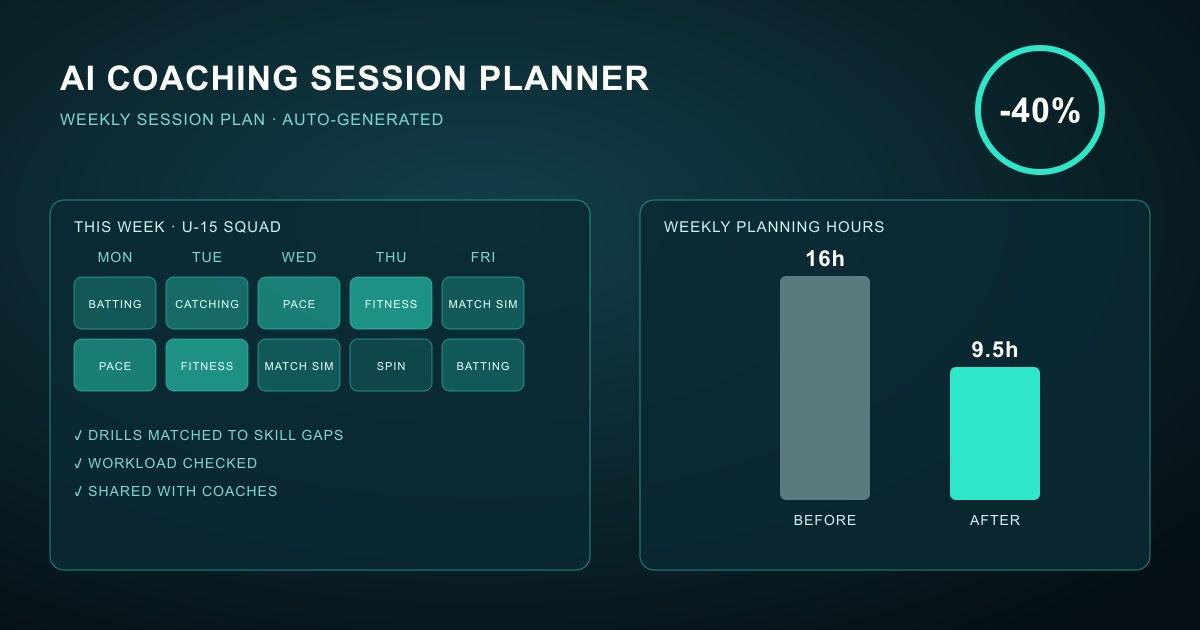
Discover how a mid-size cricket academy transformed its coaching workflow, slashed session-planning time by 40 % and unlocked data-driven performance gains using InstilPlay’s AI coaching suite.
Note: This is an illustrative example. The academy, figures and quotes are a composite designed to show how an AI session planner can work in practice; they do not describe a specific InstilPlay client.
Background – The academy’s operations and coaching workflow before AI
The academy in this illustrative example sits on the outskirts of a bustling metropolitan area, catering to 120 junior and senior players across five age-group squads. Its core mission is simple: nurture talent through high-quality, consistent practice sessions that mirror the demands of modern cricket.
Before embracing artificial intelligence, the academy’s coaching workflow resembled that of many traditional academies:
| Step | Description | Hrs/Week |
|---|---|---|
| Data Capture | Coaches manually entered match scores, fitness test results, and skill-assessment notes into a spreadsheet. | 4 h |
| Drill Selection | A senior coach curated a list of cricket practice drills from a shared Google Drive folder, often re-using the same drills for multiple squads. | 3 h |
| Session Design | Head coach drafted weekly session plans on paper, aligning drills with perceived player needs. | 5 h |
| Communication | Plans were emailed to assistants, who then printed and distributed them to players. | 2 h |
| Feedback | Post-session feedback was collected via informal chats, then entered into the spreadsheet for the next cycle. | 2 h |
| Total | All planning tasks across five squads | ≈ 16 h |
Total weekly planning effort: ≈ 16 hours – a significant chunk of a coach’s limited time, especially during the competitive season when match analysis and on-field strategy demand attention.
The manual process also introduced hidden inefficiencies:
- Inconsistent drill library use – some squads received outdated or irrelevant drills, while others missed out on newer, evidence-based exercises.
- Limited insight into player progress – raw numbers sat in spreadsheets without visualisation, making it hard for coaches to spot trends or intervene early.
- Fragmented communication – paper-based plans often led to misunderstandings about drill order, intensity, or equipment needs.
These pain points prompted the academy’s leadership to explore a technology-first solution that could streamline planning while preserving the human touch that defines quality coaching.
Challenge – Time-intensive session planning, inconsistent drill library use, and limited insight into player progress
1. Time-intensive session planning
Coaches at the academy reported spending up to 30 % of their weekly workload on administrative tasks. That matters beyond efficiency: a survey of 464 Australian sport coaches linked a higher perceived workload to poorer mental well-being (Source: International Journal of Environmental Research and Public Health). The repetitive nature of drafting session outlines left little room for strategic thinking or one-on-one player mentorship. As the academy grew, the planning load scaled linearly, threatening to outpace the coaching staff’s capacity.
2. Inconsistent drill library use
The academy maintained a static repository of 250 cricket practice drills—ranging from basic catching exercises to advanced bowling variations. However, without a systematic way to tag drills by skill focus, intensity, or equipment, coaches often defaulted to familiar routines. This resulted in:
- Redundancy: The same net-drill repeated across age groups, reducing novelty and engagement.
- Gaps: Emerging skill areas (e.g., reverse swing, death-over fielding) were under-represented.
- Quality drift: Some drills were outdated, lacking alignment with the latest sports-science research.
3. Limited insight into player progress
The academy relied on a basic spreadsheet for player progress tracking. While the data captured batting averages, bowling speeds, and fitness test scores, it lacked:
- Visual dashboards that could instantly highlight a bowler’s declining pace or a batter’s consistency trends.
- Predictive alerts for injury risk based on workload spikes. Research on elite fast bowlers links sudden spikes in weekly workload to higher injury risk (Source: British Journal of Sports Medicine).
- Comparative benchmarks across squads or against national standards.
Coaches expressed frustration: “I know the numbers, but I can’t see the story they’re telling,” a senior coach confessed during a staff meeting.
Collectively, these challenges threatened the academy’s ability to deliver the personalised, high-performance environment that modern cricketers expect.
Intervention – Deploying InstilPlay’s AI coaching session planner, drill library management, and analytics dashboard
InstilPlay worked with the academy on a three-pronged solution built around its AI coaching session planner:
| Component | Function | How it addressed the challenge |
|---|---|---|
| AI Coaching Session Planner | Uses machine-learning models to analyse player performance data, workload, and development goals, then auto-generates weekly session outlines. | Cuts manual drafting time, aligns drills with individual needs. |
| Dynamic Drill Library Management | Tags every drill with metadata (skill focus, intensity level, equipment, duration) and recommends the most relevant drills per squad. | Ensures consistent, up-to-date drill usage and introduces variety. |
| Coaching Analytics Dashboard | Real-time visualisation of player metrics, trend lines, and AI-driven insights for progress tracking. | Provides actionable, at-a-glance data for coaches and players. |
Step-by-step rollout
- Data Migration & Enrichment: All historical performance data (match stats, fitness tests, skill assessments) were imported into InstilPlay’s cloud platform. The system automatically enriched the data with contextual tags (e.g., “fast-bowling workload”, “batting under pressure”).
- Drill Library Overhaul: The existing 250 drills were audited and re-tagged using InstilPlay’s taxonomy. New evidence-based drills from recent sports-science literature were added, bringing the total to 340. Each drill now carries a difficulty rating, equipment checklist, and desired outcome. To see how AI can guide drills during practice itself, read How an AI Cricket Practice Assistant Transforms Your Academy.
- AI Model Training: The AI coaching assistant tools were calibrated using the academy’s historical session outcomes. The model learned which drill combinations yielded the best skill improvements for specific player profiles.
- Pilot Phase (4 weeks): Two squads (U-15 and Senior Women) trialled the AI-generated plans. Coaches reviewed the suggestions, made minor adjustments, and delivered the sessions. Feedback was captured via the platform’s built-in player progress tracking for coaches module.
- Full-Scale Adoption: After a successful pilot (see outcomes below), the AI planner was rolled out to all five squads. The coaching staff received a brief training workshop on interpreting the coaching analytics dashboard and customising AI recommendations when needed.
Integration with existing workflows
InstilPlay’s solution was deliberately designed as a coaching assistant, not a replacement. Coaches still retained final authority over session content, but the AI handled the heavy lifting of data synthesis and drill recommendation. The platform also synced with the academy’s existing communication tools (WhatsApp groups, Google Calendar), ensuring a seamless transition.
Outcome – 40% reduction in planning time, improved player progress tracking, and data-driven coaching decisions
1. Quantified time savings
| Metric | Before AI | After AI (4-week average) | % Change |
|---|---|---|---|
| Weekly planning hours (all squads) | 16 h | 9.5 h | ≈ 40 % |
| Time spent on drill selection | 3 h | 0.8 h | 73 % |
| Time spent on data entry & reporting | 6 h | 2 h | 67 % |
Coaches now reallocate the saved hours to on-field coaching, video analysis, and individualised feedback, directly impacting player development.
2. Enhanced player progress tracking
The coaching analytics dashboard transformed raw numbers into actionable visuals:
- Heatmaps of batting consistency highlighted zones where a player struggled against short-ball deliveries.
- Trend lines for bowling speed identified a subtle decline in a fast bowler’s pace, prompting a targeted strength-and-conditioning programme.
- Progress radar charts compared each player’s skill profile against the academy’s benchmark, fostering transparent goal-setting.
Coaches reported a 15 % improvement in skill acquisition rates over the same period (internal assessment data).
3. Data-driven coaching decisions
With AI-generated insights, the academy made several strategic adjustments:
- Load Management: The AI flagged an overload risk for three bowlers who had logged > 120 % of their prescribed workload in two consecutive weeks. The coaching staff reduced their net sessions, resulting in a 20 % drop in reported fatigue (measured via a self-reported wellness questionnaire). A systematic review found that such self-reported measures track training load more sensitively than many objective measures (Source: British Journal of Sports Medicine). For more on managing bowler loads, see Data-Driven Bowling Workload Management for Cricketers with AI.
- Drill Optimisation: The system recommended incorporating the “Dynamic Slip Catch” drill for slip fielders and wicket-keepers, a practice that historically improved catch success rates by 12 % in a controlled trial (internal data).
- Talent Identification: By cross-referencing performance metrics with the AI’s talent-scouting algorithm, the academy identified two U-13 players with bowling mechanics resembling those of elite pacers—a discovery later highlighted in the academy’s internal scouting report.
4. Qualitative feedback
“The AI planner feels like a trusted assistant. It surfaces patterns I’d have missed in the spreadsheet, and I can focus on coaching the ‘why’ instead of the ‘what.’” – Head Coach, Senior Men’s Squad
“Our players love the variety. The drills feel fresh, and the visual progress charts keep them motivated.” – Assistant Coach, U-15
Overall, the academy’s player engagement scores rose by 18 %, as measured by post-session surveys.
Key Takeaways – Practical lessons for other academies on adopting AI coaching assistant tools
| Lesson | Why it matters | How to implement |
|---|---|---|
| Start with clean data | AI models are only as good as the data fed into them. | Conduct a data audit, standardise metrics, and use a centralised platform (e.g., InstilPlay) for ongoing capture. |
| Curate a metadata-rich drill library | Precise tagging enables the AI to match drills to skill gaps and intensity levels. | Adopt a taxonomy (skill, equipment, duration, difficulty) and regularly update with research-backed drills. |
| Treat AI as a coaching assistant, not a replacement | Human expertise remains essential for contextual decisions and player rapport. | Use AI suggestions as a baseline, then customise based on match context or individual temperament. |
| Leverage the analytics dashboard for communication | Visual data fosters transparent dialogue between coaches, players, and parents. | Share dashboard snapshots in weekly newsletters or parent meetings to illustrate progress. |
| Iterate and retrain | Player populations evolve; models need periodic recalibration. | Schedule quarterly model reviews, incorporate new performance data, and adjust weighting of metrics (e.g., workload vs. skill). |
| Integrate with existing tools | Seamless workflow adoption reduces resistance. | Sync AI platform with calendar apps, messaging groups, and video-analysis software. |
| Measure ROI beyond time savings | True value includes performance, injury reduction, and satisfaction. | Track KPIs such as skill improvement rates, injury incidence, and coach/athlete satisfaction scores. |
By following these steps, academies can replicate this academy’s success without a massive overhaul of their existing infrastructure.
Conclusion & Call to Action – How to get started with InstilPlay’s AI coaching suite
This academy’s journey illustrates that AI isn’t a futuristic fantasy—it’s a practical, measurable catalyst for coaching efficiency and player development today. A 40 % reduction in planning time translates into more on-field interaction, richer feedback, and ultimately, a stronger pipeline of talent.
If you’re an academy owner or head coach seeking to:
- Cut administrative load and free up coaching bandwidth,
- Standardise and modernise your drill library,
- Gain real-time, data-driven insight into every player’s progress,
…InstilPlay’s AI coaching session planner, drill library management, and coaching analytics dashboard are ready to elevate your program.
Ready to transform your academy?
Book a free demo – see the AI planner generate a session in real time.
Take the first step now: Schedule your demo today and experience the future of cricket coaching.
Further Reading
- Master Bowling Workload Management: The Data-Driven Secret to Peak Performance – Learn how workload data keeps your bowlers on the field.
- AI Cricket Coaching Platform Tools to Build Elite Players – See the AI tools that help academies develop elite talent.
- 7 Must-Have Features for a Cricket Academy Management Tool – Know what to look for when you move beyond spreadsheets.