How an AI Cricket Practice Assistant Transforms Your Academy
By Manideep Dhar & Sharat Chandra Kumar Manikonda
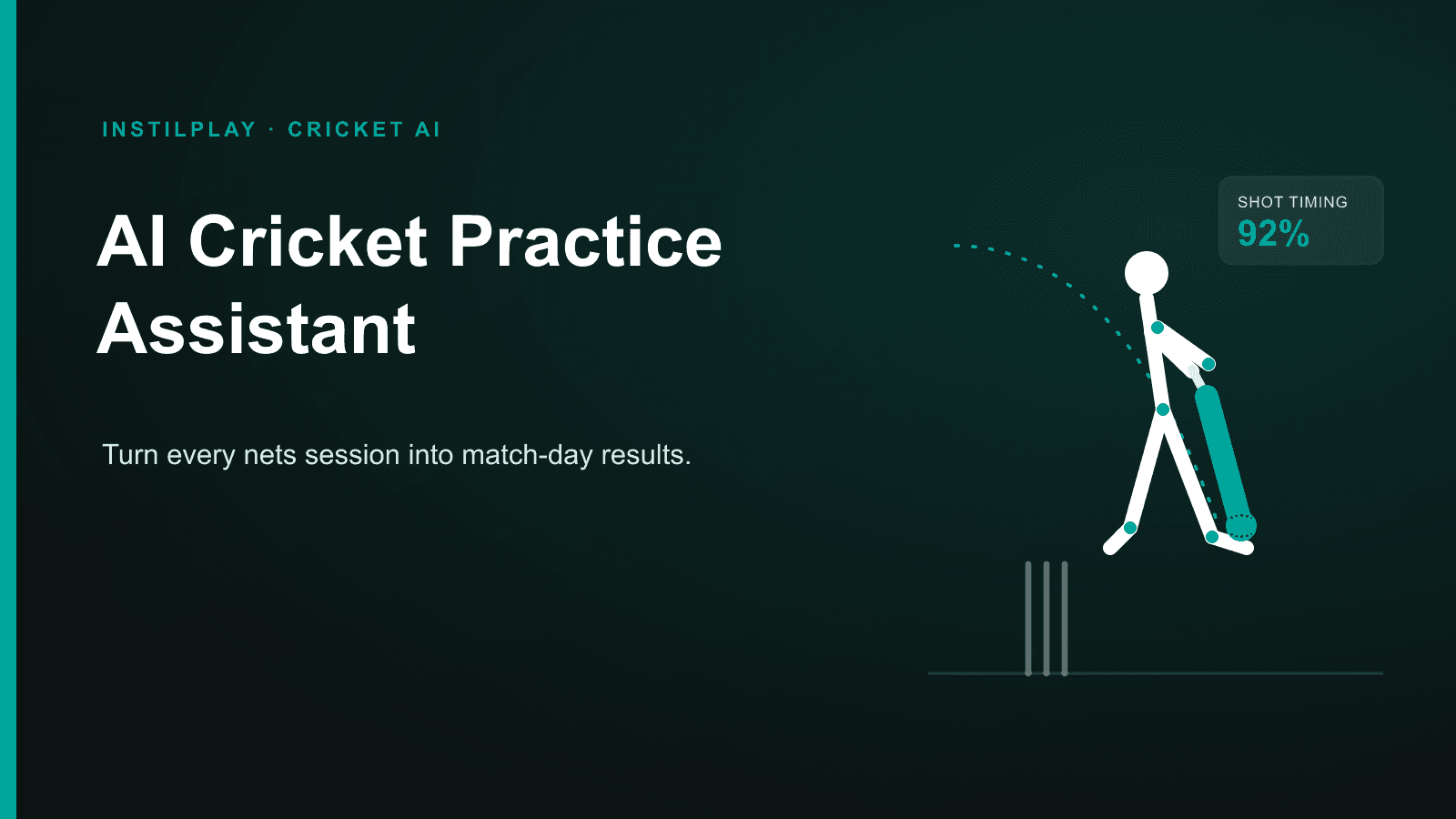
If you run a cricket academy or coach multiple squads, this will sound familiar. Your players train hard, nets are full, coaches are busy. Yet match-day numbers and selection conversations still do not quite reflect all that effort.
You see hundreds of balls being faced and bowled every week, video files piling up, fitness sessions squeezed in, but all these still feel like everyone is guessing more than growing.
What you are missing is not the effort. It is the system—the way you capture what players actually do in practice, understand it, and turn those into smart, repeatable improvement across your entire academy.
That is exactly what an AI cricket practice assistant (a modern, data-driven player practice assistant or AI cricket coaching app) is built to do (Sources: Technology in Cricket Coaching, Tezeract AI).
In this insightful guide, we will show you how an AI-powered assistant, like InstilPlay (Instil-it's advanced AI sports management platform), can help you:
- Automate practice session logging with accurate and structured data.
- Turn raw numbers into personalized drill recommendations.
- Visualize skill improvement tracking with benchmarked dashboards.
- Provide real-time performance insights during nets.
- Translate stats into SMART goals and motivation loops.
- Align fitness tracking with skill loads to reduce injury risk.
- Supercharge practice video analysis.
- Connect players, coaches and academy managers on one integrated platform.
This is one of those pieces you would definitely want to bookmark and share with your coaching staff or fellow academy managers as it is designed to be your academy's handbook for AI-driven training.
At a Glance: What an AI Practice Assistant Does (Academy View)
Think of this as your quick "infographic" snapshot in a tabular format.
| Your current struggle as an academy / coach | What the AI cricket practice assistant does | What it feels like for you |
|---|---|---|
| You do not know exactly what each player did in a session | Automatically logs drills, reps, speeds, location and context | You finish a session and each player's workload is already organized |
| Coaches recycle the same generic drills | Analyses player data and recommends targeted batting, bowling and fielding drills | Every session starts with a focused, personalized plan |
| Players "feel" better but cannot prove it | Plots key metrics over time and against benchmarks | You can quickly show progress (or plateaus) to players and parents |
| Players pick up niggles from unbalanced loads | Syncs wearables, tracks workload and recovery, suggests smarter conditioning | You train smarter, not just harder, across the whole squad |
| Video review is chaotic and time-consuming | Auto-clips and analyses footage, highlighting key technical issues | Reviewing video becomes quick, focused and coach-friendly |
| Head coach lacks a single, central view of the academy | Provides shared dashboards, reports and drill assignments | Everyone including the staff, players, owners, is finally looking at the same picture |
Keep this table in mind as each section dives deeper.
1. Automate Practice Session Logging So Your Data Is Finally Trustworthy
Why manual logs quietly sabotage your academy?
Traditional practice journals and manual spreadsheets rely heavily on memory. Hours after the nets, even good coaches do not remember the exact number of deliveries, ball speeds, lengths, or drill context for every player (Sources: National Library of Medicine, PlayerData).
Those gaps turn into inaccurate baselines. Coaches end up prescribing workloads based on what they think happened, not what actually happened, leading to under-training some players and quietly overloading others (Sources: Sportplan, Cheshire Cricket Board).
Researches on holistic frameworks such as the Cricketer Performance System (Source: Cricket Matters) shows that combining technique, movement, strength, mindset and recovery delivers consistent match performance only when it is driven by reliable data rather than guesswork (Sources: ResearchGate, Crickingdom).
Research exploring elite athlete monitoring practices highlights that manual data collection is one of the largest drains on coaching resources. Transitioning to automated logging not only buys back hours of weekly coaching time, but it guarantees workload metrics are reliable enough to base match-day decisions on (Source: Taylor & Francis). For an academy, that is the difference between rough impressions and a genuinely trustworthy data foundation.
What the AI practice assistant does instead?
A modern AI cricket practice assistant eliminates manual logging pain by:
- Voice-activated capture – "Log batting drill – 30 balls, focus on late-shot timing." The assistant transcribes drill name, repetitions and notes in real time (Source: Speakwise).
- Sensor integration – Wearable accelerometers and smart balls send ball-by-ball data (speed, spin, trajectory) straight into the log, removing manual entry errors (Source: ESPNcricinfo).
- Smart tagging – Automatically labels work as batting, bowling, fielding or fitness so you can analyze loads by domain later (Source: MDPI).
- Automatic timestamps and geo-tags – Every session is time-stamped and geo-tagged, giving you a reliable audit trail across pre-season, in-season and tournament phases (Source: Sports Medicine).
- Cloud sync – All sessions are stored centrally, backed up and accessible from any device for both coaches and players (Source: AWS Sports).
Quick implementation tips: This blog recommends two simple habits that can scale nicely in an academy:
- Before a block – Start each major block with a 30-second voice command: e.g. "U19 nets: 90 balls per player, focus on short ball and strike rotation."
- After each drill – Spend 10 seconds confirming or editing the assistant's entry on a phone or tablet.
Over a week, you end up with a complete, searchable log for every squad, without adding spreadsheet work.
2. Turn Raw Numbers into AI-Generated Personalized Drill Recommendations
From generic drills to data-driven specificity
One-size-fits-all drill libraries waste valuable training hours. They ignore each player's unique strengths and weaknesses. An AI cricket practice assistant flips this by analyzing logs, comparing them against proven cricket drills, and surfacing targeted work for batting, bowling and fielding (Source: Tezeract):
- Skill gap detection – Flags low-performing metrics like "outside-off-drive foot placement", "release-angle consistency" or "reaction time on high catches" (Source: Tezeract).
- Evidence-based library – Draws from a curated pool of drills validated by biomechanics research and elite coaching curricula (Source: Quintic Sports).
- Dynamic sequencing – Adjusts drill difficulty and focus as players improve, maintaining progressive overload (Source: Motor Learning in Sports).
Decades of research into motor learning and the Contextual Interference Effect proves that transitioning players from generic 'blocked' practice into highly targeted, randomized drill sequences significantly enhances long-term skill retention and translates directly to higher match-day performance (Source: Motor Learning in Sports).
Watch: Motor Learning: Block vs Random Practice
Concrete Drill Mapping (AI-Assisted)
Here is how AI assistant can map input data to specific drills (Source: StanceBeam):
| Input Data | AI Interpretation | Recommended Drill |
|---|---|---|
| Batting: high miss-rate on short-outside off-stump | Identifies timing gap on earlier-length deliveries | Late-shot timing drill with a short-length machine at ~70 km/h |
| Bowling: consistent line but low wicket-taking | Detects lack of variation in spin axis | Variation spin drill using a spin-sensor ball to encourage finger roll |
| Fielding: slower reaction time on high catches | Highlights neuromuscular latency | Reaction-ball drill with LED-triggered balls giving ~0.2 s stimulus |
Example: Shadow Footwork Circuit
A specific example for the Shadow Footwork Circuit, designed to fix inconsistent back-foot balance when playing on the front foot (Source: Vanta Sports):
- 3 sets of 10 seconds.
- Alternate between forward and backward steps.
- Maintain a stable base and head position throughout.
Watch: Mastering Front and Back Foot Movements
"Skill Gap Alert" feature When the AI-assistant detects a dip, say a 15% drop in batting strike rate over three sessions, it can push three drill options with video demos so that the coaches and players can respond immediately instead of waiting for end-of-month reviews.
3. Track Skill Improvement with Benchmarked Progress Charts
Turning numbers into motivation Seeing a line graph rise over weeks is far more motivating than a vague statement "We're improving". An AI Player Practice Assistant visualizes key metrics against personal baselines and industry benchmarks (Source: PitchVision):
- Batting – IoT bat sensors (like StanceBeam and Str8bat) and AI computer vision currently set the standard for generating batting heat maps, 360-degree wagon wheels, and footwork efficiency scores without requiring match-day umpires.
- Bowling – Ball-tracking AI and smart-ball technologies track the exact RPM (revolutions per minute) on the spin axis, release speeds, and generate "beehive" pitch maps to visualize line-length consistency exactly like TV broadcasts (Source: Kookaburra Sport).
- Fielding – Catch success ratio, ground-ball pickup time, throw accuracy and error rate (Source: Catapult Sports).
Each module updates in real time as drills and match-sim sessions are logged.
Research published in Sports Biomechanics confirms that providing athletes with augmented visual feedback, like foot-placement heat maps or velocity charts, accelerates the correction of technical flaws far faster than verbal coaching alone. Furthermore, studies on athlete motivation show that when players have access to their own objective weekly dashboards, it creates a powerful psychological feedback loop. They stop just 'hitting balls' and start training with purpose, driving higher intensity and faster skill acquisition in every net session.
Benchmarks and peer percentiles The AI practice assistant can anonymously aggregate data from players at similar skill levels and provide a peer percentile view:
- A bowler might sit in the 70th percentile for speed but only the 40th for spin variation.
- A top-order batter might be above average on full-length balls but below average on short-of-a-length outside off-stump. This instantly tells coaches what to emphasize in the next micro-cycle.
Snapshots and alerts Two simple habits that is recommended and fits perfectly for academies:
- Weekly "Progress Snapshot" reminder – Coaches and players review charts, note trends, and adjust upcoming drills accordingly.
- Daily snapshot alerts – For example: "Your bowling dot-ball % is up 4% this week, goal: 55% by month-end." This keeps data actionable without overwhelming players.
4. Real-Time Performance Insights to Fine-Tune Technique in the Nets
Feedback while the feel of the ball is still fresh During live sessions, the AI practice assistant can siphon and process sensor data (accelerometers, gyroscopes, smart balls) and deliver performance insights for players in real time (Source: MDPI):
- Batting – Detects early bat-head lag, suggests a quicker downswing (Source: StanceBeam).
- Bowling – Flags an open-shoulder release, recommends a shoulder-tuck cue (Source: Taylor & Francis).
- Fielding – Highlights delayed foot-plant during ground-fielding attempts (Source: Journal of Strength and Conditioning Research).
These come through subtle haptic alerts, short on-screen cues, or quick audio prompts, so the players can correct technique without breaking the flow of practice.
Biomechanical researches link footwork effectiveness (70–88% in youth cohorts) to higher shot-execution rates, and real-time feedback helps cement correct movement patterns before bad habits set in (Source: Sports Biomechanics, Journal of Motor Behavior).
The "Alert → Mirror-check → Adjust" loop This blog recommends a simple loop to try on:
- The AI practice assistant triggers an alert (e.g. "front shoulder opening too early").
- Player pauses briefly, checks the last rep (video or mental replay).
- Player makes a conscious adjustment on the very next delivery.
Repeat this loop and the correction becomes automatic, without needing a coach standing next to every ball.
5. Instant Performance Insights, SMART Goals and Motivation Loops
From raw numbers to decisive action Raw numbers only help if they lead to actionable insights. The AI Player Practice Assistant like InstilPlay, developed by the innovators at Instil-it, converts analytics into short, digestible narrative summaries:
- "Your spin bowling accuracy improved by 8% this week, but release speed dropped 2 km/h. Focus on wrist-snap drills to regain pace".
- "Your strike rate against short-of-a-length balls outside off-stump is 18% lower than your overall strike rate. Prioritize late-shot timing drills next week".
On top of this, the InstilPlay's goal-setting wizard helps you define SMART (Specific, Measurable, Achievable, Relevant, Time-bound) goals:
- Define the metric – e.g. increase footwork efficiency from 72% to 80%.
- Choose a timeframe – e.g. 4 weeks.
- Assign drills – Assistant schedules recommended drills (for example, footwork circuits) three times per week.
- Monitor compliance – System logs completed sessions and sends gentle nudges if a session is missed. Goal-setting is a cornerstone of frameworks like the Cricketer Performance System (Source: AASP), InstilPlay simply operationalizes it at scale.
Motivation loops and real-world success story Motivation loops that are worth preserving include:
- Digital badges – For streaks like "10 consecutive sessions logged without missing a drill".
- Leaderboards – Within teams or squads to keep training fun and competitive.
- Habit tracking – For small habits (e.g. "10-minute visualization before nets") that support larger performance goals.
A semi-professional all-rounder described in the drafts used the goal-setting module to raise batting strike rate from 72% to 84% over eight weeks; by following InstilPlay's AI-curated drill plan and fitness adjustments, he also saw about a 5% improvement in bowling economy, demonstrating the cross-benefits of holistic, data-driven coaching.
6. Integrated Fitness Tracking to Align Conditioning with Skill Work
The missing link between skill and fitness Cricket performance hinges on the synergy between technical skill and physical capacity. Over-training a skill without supporting endurance leads to fatigue-related errors while under-training conditioning means skill gains never fully translate to match situations.
An AI-powered assistant like InstilPlay bridges this gap by:
- Wearable sync – By siphoning data from smart wearables and further integration with InstilPlay and connecting heart-rate monitors, GPS trackers or smart shirts so that VO₂ max, sprint speed and recovery metrics sit alongside skill data.
- Dynamic workload balancing – If nets show a heavy bowling load (e.g. 120 balls at 135 km/h), InstilPlay can suggest a lower-impact conditioning routine (like mobility, yoga etc.) that day.
- Recovery insights – Factoring sleep quality and HRV (heart-rate variability) into recommendations so you do not stack high-intensity sessions on incomplete recovery.
One example to relate it: after a 45-minute power-hitting session, the InstilPlay notes a 15% dip in post-session HRV and recommends a low-intensity active recovery block before the next fielding drill.
Longitudinal studies published in the British Journal of Sports Medicine prove that integrated skill and fitness monitoring is non-negotiable for injury prevention. Research shows that unmonitored spikes in workload drastically increase the risk of soft-tissue and bone stress injuries in cricketers, whereas continuous, data-driven load monitoring actively protects players and keeps your best talent on the pitch.
Rules and case studies to carry into your academy This blog proposes practical rules such as:
- "Fitness-Skill Sync" rule – When weekly bowling volume exceeds 1,500 deliveries, auto-schedule two lower-body strength-endurance sessions.
- Weekly "Fitness-Skill Fusion" report – Each Sunday, review a combined view of bowling volume, conditioning loads, recovery markers and red flags, then adjust the following week's plan.
A professional fast-bowler example shows that using this kind of assistant to balance bowling workload and sprint intervals led to a ~3 km/h increase in bowling speed over six weeks while injury-risk markers stayed flat, a direct result of data-driven conditioning.
7. Practice Video Analysis for Instant Technique Corrections
Why video is powerful but underused Video remains the gold standard for technical analysis, but manual tagging and clipping are time-consuming. In real academies, coaches do not have hours to sit and cut film.
InstilPlay solves this by automatically:
- Importing recorded clips from practice sessions
- Applying computer-vision algorithms to identify balls, shots and key events
- Highlighting key technical moments via auto-clipped segments It then generates:
- Frame-by-frame breakdowns of bat-swing paths
- Heat-maps of foot placement during back-foot and front-foot movements
- Overlayed biomechanical angles (e.g. ideal release positions for bowlers) From there, InstilPlay produces concise "actionable insights" cards such as:
"Your front-foot stride length is about 15% shorter than the optimal range; add 2-metre stride drills."
Research published in the Journal of Sports Sciences highlights that augmented video feedback significantly accelerates motor skill acquisition. By instantly bridging the gap between what an athlete feels they are doing and what the objective data shows, AI-augmented review allows players to correct biomechanical flaws much faster than through traditional, verbal-only coaching.
How to maximize video analysis To get the most from AI-driven video analysis in your academy:
- Record from stable angles—behind the stumps for batting, side-on for bowling.
- Tag the session once; the assistant auto-segments each delivery or shot.
- Review AI-generated insights before the next practice and apply suggested corrections in that session. This turns video from a burden into a weekly habit.
8. Sync with Coaches for Collaborative Player Management (InstilPlay vs Other AI-Assisted Coaching Apps)
Coach portals and collaborative workflows Even the most sophisticated AI works best when paired with human expertise. A key feature is the coach portal, where mentors can:
- View player dashboards in real time
- Assign custom drills or modify AI-suggested ones
- Leave voice notes tied to specific sessions
- Run comparative analyses across the squad to spot emerging talent or injury risk For player-coaches juggling their own game and coaching responsibilities, this centralizes everything that previously lived on chalkboards, notebooks and scattered apps.
InstilPlay v/s Other AI-Assisted Cricket Coaching Apps
The AI cricket space already includes tools like CricMetry, CricVision, Ludimos, CrickCoach AI and Fulltrack AI, which emphasize various combinations of AI-driven coaching, analytics, ball tracking, replay and academy management.
- CricMetry focuses on personalized analytics and dashboards for players, coaches, clubs and leagues.
- CricVision offers AI cricket coaching with delivery replays, real-time feedback and pro comparisons.
- Ludimos positions itself as an all-in-one AI cricket coaching and academy-management platform with ball-by-ball review.
- CrickCoach AI markets itself as a personal AI coach analyzing batting and bowling videos for instant feedback.
- Fulltrack AI focuses on AI ball tracking and automated stats and highlights using only a phone camera.
These products are strong point solutions, especially for individual players or specific functions like video or ball tracking.
InstilPlay, by contrast, presents itself as a broader AI sports management platform:
- It includes a Player Practice Assistant (AI cricket practice assistant) that does everything described above.
- It also adds academy-management capabilities: tracking attendance, managing payments, handling enrolments and coordinating coaches—all from one place.
For academy owners and coaching directors, InstilPlay interprets to be your AI coaching layer and your operational backbone, rather than just another isolated app.
A Short Story: How an Academy Turned Chaos into a Data-Driven Culture
Imagine a mid-level academy facing the problems both drafts described:
- One coach uses a notebook, the other lives in a personal spreadsheet.
- Parents constantly demand updates and evidence of progress.
- No one can see workloads or development across the whole squad. Then they adopted InstilPlay as their AI cricket practice assistant as the centerpiece.
Within one season:
- Every net, fitness and fielding session started getting automatically logged per player.
- The head coach started a 15-minute weekly review with dashboards instead of a two-hour debrief.
- Players started getting individual drill recommendations and SMART goals visible in their own app.
- Bowling volumes and conditioning loads got balanced using Fitness-Skill Sync rules and weekly Fitness-Skill Fusion reports, cutting down niggles.
- Selection meetings made use charts and metrics, not just memory and gut feel. Coaches started spending more time in practical coaching, and less in chasing data. Owners felt more in control of both performance and operations.
This is exactly the transformation this blog is pointing to—now brought together into one coherent, academy-focused story.
Summary: One Core Problem, Eight Reinforcing Solutions
To close, return to the one core problem we wanted to solve:
Your players train hard, but without structured, trustworthy data, improvement is slow, random and difficult to repeat across squads.
An AI cricket practice assistant, especially when it's InstilPlay—an advanced AI sports management platform developed by Instil-it, addresses that problem through eight reinforcing capabilities:
- Automated practice session logging that builds a reliable data foundation.
- Personalized drill recommendations that target each player's real gaps.
- Skill improvement tracking with charts, benchmarks and peer percentiles.
- Real-time performance insights that catch technique issues in the moment.
- SMART goals and motivation loops that keep players moving forward.
- Integrated fitness tracking that aligns conditioning with skill loads and reduces injury risk.
- AI-powered video analysis that makes technical review far more efficient.
- Coach portals and academy-wide management that connect everyone on one platform. Do this well and the technology fades into the background. What you and your staff actually experience is simple:
- More clarity in training plans
- More confidence in selection and communication
- More consistent performances across your academy
Your Next Season Starts Here
If you are:
- An academy owner looking for training and operations in one modern and advanced AI system
- A head coach wanting a clear, shared picture of player workloads and progress
- A club or school sports programme lead wanting data-backed communication with parents and players
…then this is the moment to pilot an AI cricket practice assistant instead of adding another spreadsheet or one more standalone app.
Here is a simple next step plan:
- Bookmark this guide and use it as a checklist when evaluating any AI cricket coaching platform or app.
- Share it with your coaching group and ask: "Which of these eight capabilities would change our academy the most this season?"
- Explore how InstilPlay, built by Instil-it, brings all of these together, from Player Practice Assistant to full academy management, and, if it feels like a fit, book a demo or walkthrough with the team.
If you are also curious about the tech under the hood, and want to explore how AI, Gen AI, Data Science and Advanced Analytics power platforms like InstilPlay, Instil-it offers training programs on these topics for organizations, coaches, professionals and even individuals.
However, when you move forward, do not go into another season with your training data scattered and your progress left to guesswork.
Let AI handle the tracking and analysis, so that you and your staff can focus on what you do best: developing players, winning matches and building a standout cricket academy.