Spin Bowling Variations: How Biomechanics and AI Turn Good Spinners Into Match-Winners
By Manideep Dhar & Sharat Chandra Kumar Manikonda
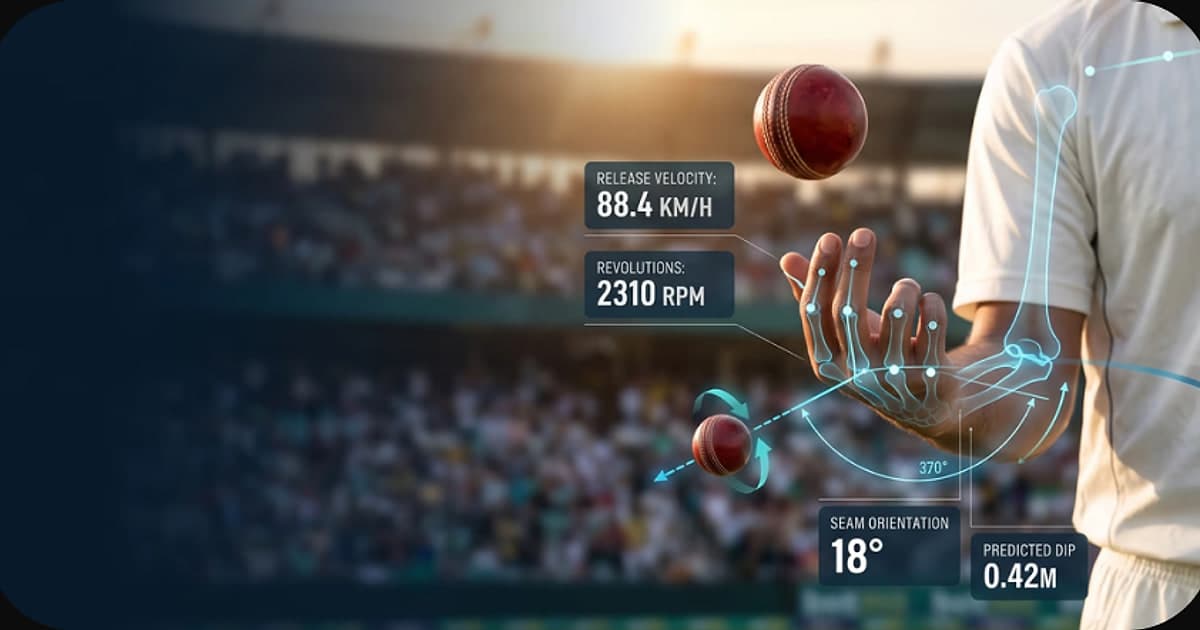
If you coach spin bowling and feel your bowlers should be taking more wickets with their googlies, doosras and flippers, but you cannot quite turn that feeling into repeatable results, this article is for you. You already know the names of the key spin bowling variations; what is often missing is a reliable way to see the biomechanics and performance signals behind each delivery so coaching becomes measurable instead of guesswork (Source: Indian Journal of Orthopedics).
The Problem Coaches Really Want To Be Solved
Most spin bowling coaching still depends on observation, instinct and repetition. A coach spots something, offers a cue like "use more wrist" or "stay balanced," and hopes the next few balls to improve. The problem is that without data, and the meaningful insights that can be skimmed from those data, it is difficult to confirm whether spin rate changed, release angle improved, or landing position became more stable (Sources: Journal of Sports Sciences).
That matters because spin bowling is shaped by small mechanical changes. Research and technical analyses show that wrist orientation, shoulder rotation, elbow action and front-foot placement all influence the ball's spin, drift, bounce and control (Sources: Sensors). When those variables are measured clearly, coaching shifts from vague language to precise, repeatable correction (Sources: Sensors).
But how to capture those data, how to compute them to derive the exact set of insights that the coach needs? Well, by the end of this you would have the entire picture distinct and clear.
Why Spin Bowling Biomechanics Matter?
Spin bowling is a game of tiny margins. This blog highlights the biomechanics principle which demonstrates that a 5-degrees change in wrist orientation can alter the spin axis by around 10 degrees, changing drift and bounce in ways the naked eye may miss (Source: Procedia Engineering). Published biomechanics researches also show that spin bowling effectiveness is strongly linked to how bowlers convert torque and segmental movement into spin rate (Sources: Indian Journal of Orthopedics, Journal of Sports Sciences).
There are also evidences that off-spin and leg-spin are mechanically distinct techniques rather than slight variations of one standard model (Sources: Sports Biomech, Kinesiology in Sports). That is important for coaches because it means different spin bowling variations should not be taught with one generic template. A googly, doosra or flipper works best when the bowler understands the specific release mechanics behind that delivery (Sources: Sports Biomech, Sensors).
The four levers behind spin bowling variations:
- Wrist angle at release: Wrist position is one of the clearest markers of how a variation behaves. Various studies identified wrist flexion and extension as central to spin direction and spin magnitude, with different angle ranges supporting leg-spin and off-spin actions (Sources: Journal of Society of Indian Physiotherapists). For practical coaching, that means the bowler should not just be told to "flick it more"; the coach should define a repeatable wrist window for the stock ball and for each variation (Source: MDPI Sensors).
- Release angle: Release angle affects how the ball travels through the air and how it reacts off the pitch. Some key studies noted that topspinners, googlies and other variations benefit from subtle but meaningful differences in launch angle (Sources: Biomechanics in Sports, Applied Sciences MDPI). High-speed video is often enough to make this visible, which is why even low-cost analysis setups can create immediate coaching value (Source: CoachNow).
- Shoulder rotation speed: Shoulder rotation helps generate the angular velocity that is transferred into the ball. The elite shoulder external rotation speed in the 300–350°/s range, and published biomechanics literature supports the importance of upper-body mechanics and segmental movement in producing the spin (Sources: Journal of Sports Sciences, South African Journal of Physiotherapy). In coaching terms, more revs do not come from "trying harder"; they come from a better sequence of loading, rotation and release.
- Front-foot placement and stride length: A bowler cannot consistently deliver sharp spin if the base is unstable. Researches tie front-foot placement and stride length to balance, torque generation and reduced slip-over risk (Sources: Quintic Sports, University of Sydney). For coaches, this turns landing position into a trainable target rather than an afterthought, especially for bowlers struggling to repeat turn-over deliveries under pressure.
A Simple Visual Map for Coaches
A useful way to think about spin bowling analytics is as a four-part map:
- Variation type: Googly, Doosra, Flipper, Slider, Topspinner.
- Wrist target: What hand position is needed at release?
- Rotation target: What shoulder and arm speed pattern supports the delivery?
- Landing target: Where the bowler needs to land to stay balanced and repeatable?
When coaches map a variation this way, the bowler stops hearing scattered tips and starts seeing a full movement pattern they can repeat.
Tools That Make Invisible Mechanics Visible
A full biomechanics lab is helpful, but it is not the only route into quality spin bowling analysis. This blog outlines several practical tools, from high-speed video and inertial measurement units to pressure-sensing mats and integrated analytics platforms.
A realistic starting setup for many sports clubs or academies look like this:
- High-speed video for release angle, wrist position and front-foot placement (Source: IJISRT).
- A wearable sensor or IMU for wrist and shoulder movement data (Source: IJARCCE).
- A landing grid or pressure-based surface for foot-placement feedback (Source: MDPI Sensors).
- An AI sports analytics tool like InstilPlay that pulls the data into one coaching view.
This is where an AI-enabled workflow becomes powerful. Instead of collecting clips, notes and isolated observations, coaches can connect them into a single performance story around spin rate, consistency, drift and bounce. And InstilPlay is an appreciable tool to rely on for the same.
A Short Coaching Story
Imagine a leg-spinner whose googly looked dangerous during the trainings but rarely yielded wickets during the matches. The coach kept on saying "hide the wrist better", yet the deliveries remained inconsistent. Once video and wrist data were reviewed together, a pattern appeared: the wrist position varied too much and the front foot landed outside the bowler's ideal zone on too many attempts.
Now the feedback changed from vague to specific: hold the googly wrist shape within the target band and land in the same channel more often. The bowler is no longer trying to guess what a good googly feels like, instead the bowler can see it, repeat it and improve it.
Practical drills for the next net session:
- Wrist-lock drill: Use high-speed video or a wrist sensor to track the bowler's release position for one stock ball and one variation. The goal is to reduce unnecessary variation in hand position so the delivery becomes more repeatable over a spell.
- Variation-only sets: Choose one variation for the session, such as the doosra or googly, and bowl it in a dedicated block rather than mixing it randomly with the stock ball. This helps isolate the specific movement pattern and makes side-by-side video review more useful.
- Front-foot landing grid: Mark a landing box and track how often the bowler lands inside it over 15 to 20 deliveries. Consistent landing helps preserve balance and supports more reliable release mechanics.
How InstilPlay Fits Here?
For many academies, the challenge is not understanding that data matters; the challenge is managing it consistently across bowlers, sessions and competitions. AI sports management platforms like InstilPlay are increasingly being used across cricket analytics workflows to combine tracking, video and decision support.
InstilPlay's positioning fits naturally into that need in a leading plot. InstilPlay can be presented as an exclusive and future ready AI sports management platform that helps coaches, academies and clubs capture performance data, review cricket bowling analysis more efficiently, and turn coaching observations into structured, usable insight.
Summary
Spin bowling variations are not magic tricks; they are repeatable movement patterns shaped by wrist angle, release angle, rotation speed and stable landing mechanics. Coaches who measure those variables can improve clarity, consistency and development speed for their bowlers. And when those insights are supported by AI-driven analysis, supported by platforms like InstilPlay, the path from coaching instinct to data-based performance becomes much easier to scale.
Your Step Ahead
A practical next step is to review one spinner's footage and delivery data through a structured AI-drive analytics lens with the help of InstilPlay, then compare the stock ball against one variation. That creates a low-pressure way for academies and clubs to see how AI-assisted cricket analysis can sharpen coaching decisions before expanding across the wider programme.