How LLMs and AI Agents Finally Start Doing the Work for You
By Manideep Dhar & Sharat Chandra Kumar Manikonda
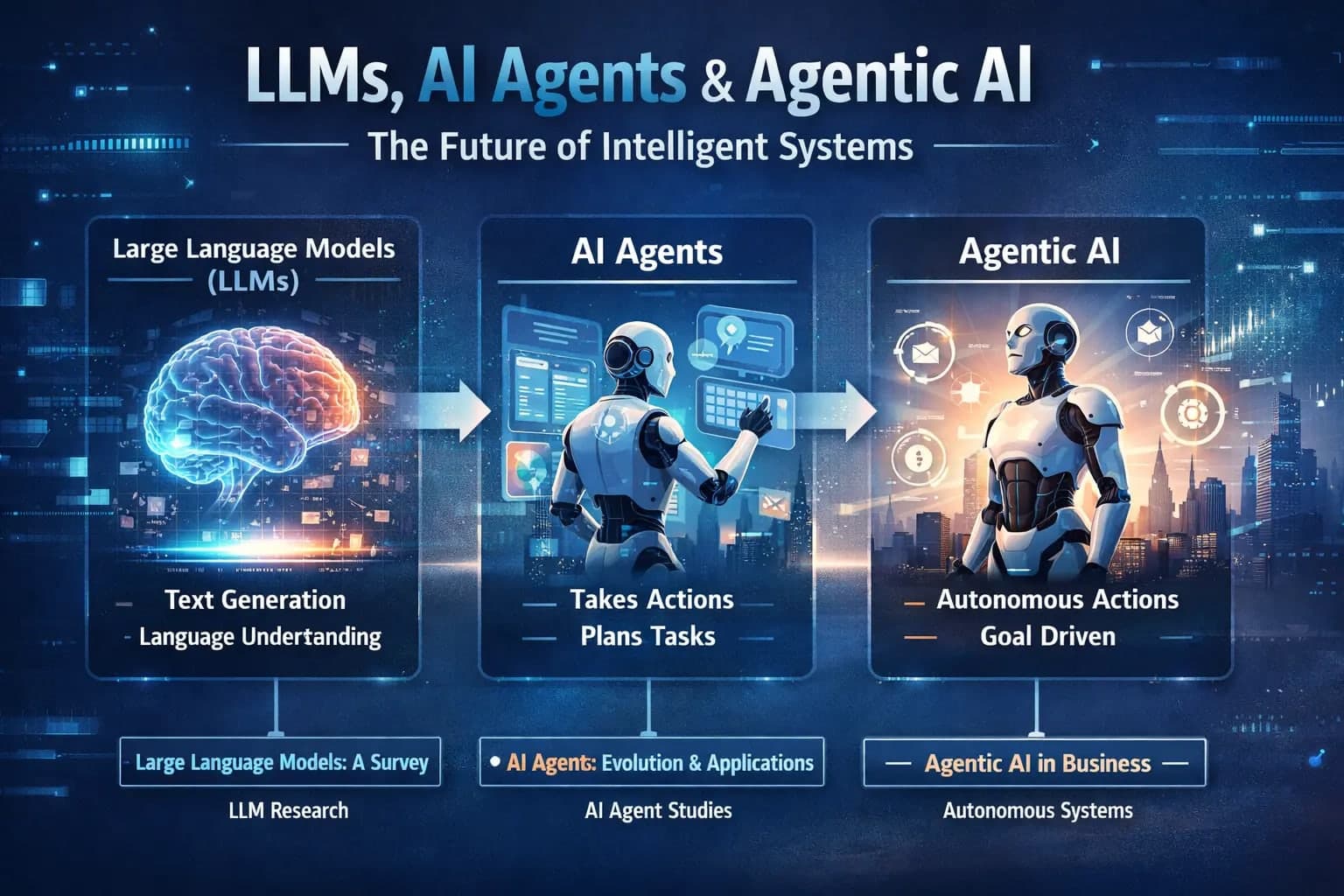
If you're tired of "cool AI demos" that never move a single KPI, this is for you.
Maybe you've already tried a chatbot, experimented with a large language model (LLM), or built a small Generative AI pilot, but your workflows still run on manual effort, late‑night spreadsheets, and heroic brainstorming on non-value added tasks. Deep down, you don't want another assistant that just talks. You want AI that actually does the work: qualifying leads, updating CRMs, drafting proposals, following up customers, running reports.
That's exactly where LLMs, AI agents, and Agentic AI for business for you come together.
Quick Tip: Save this for later—you'll want to bookmark it when you start mapping your first automated workflow.
The One Problem We're Exploring
Core problem: "How do I move from chatbots that only answer questions to AI systems that actually run real-world workflows end‑to‑end?"
You've seen what an LLM can do in a chat window. It writes emails, explains code, drafts documents. But when you ask, "Can this AI actually log into my systems, follow a process, and get work done?"—things get fuzzy.
In this blog, we'll:
- Explain LLMs, AI agents, and Agentic AI in plain, non‑technical language.
- Show you why Agentic AI matters for workflow automation.
- Give you a simple, practical roadmap to identify and launch your first agentic AI workflow in your business.
Promotion stays light. The goal is that you leave thinking, "I finally get it—and I know what to do next."
LLMs: The Brains That Understand Language
Think of a Large Language Model (LLM) as a brilliant intern who has read almost everything on the internet. It's amazing at:
- Understanding messy, human language.
- Generating well‑structured text: emails, code snippets, summaries, proposals.
- Keeping context across a conversation.
LLMs are predictive text engines trained on huge datasets, which is why they're so versatile—from drafting documents to answering customer questions. But on their own, they mostly talk; they don't reliably log into your CRM, update tickets, or trigger workflows in your tools. (Source: Cornell University arXiv publication; Quiq Blog).
But on their own, they mostly talk; they don't reliably log into your system or trigger workflows in your system using your tools.
So, if LLMs are the "brains", what's missing? Arms and legs.
AI Agents: From Answers to Actions
AI agents are LLMs with those missing arms and legs.
An AI agent is a system that can:
- Interpret your goal.
- Plan a sequence of steps.
- Use tools and APIs (CRMs, email platforms, databases).
- Execute multi‑step tasks autonomously, not just answer a single question. (Source: Boomi)
For example, a sales AI agent might:
- Read a new lead from your website form.
- Check the company on LinkedIn.
- Score the lead based on your rules.
- Draft a personalized outreach email.
- Log everything in your CRM.
All this can run without a human manually clicking through each step, as long as you give the agent the right tools and guardrails. (Source: Good Data; IBM)
This is where phrases like AI agents for workflow automation become real—not a buzzword.
Agentic AI: A Whole AI Team Running Your Workflows
Now imagine not just one AI agent, but a small AI team—each "person" with a role. That's Agentic AI in simple terms.
Agentic AI is an approach where multiple AI agents work together, using LLMs as their "brains" and tools as their "hands", to autonomously plan, coordinate, and execute end‑to‑end workflows with minimal supervision. (Source: IBM)
In practice, that might look like:
- One agent researching a prospect.
- Another drafting a proposal.
- Another checking pricing and margins.
- A "coordinator" agent reviewing everything, asking for corrections, and only then sending it to a human for approval. (Source: IoTWorlds)
Compared with basic chatbots, Agentic AI for business is about doing, not just saying:
- It handles complex, multi‑step processes.
- It adapts in real time when something unexpected happens.
- It can backtrack, correct itself, and keep going. (Source: RedHat)
This is where real workflow automation, even across multiple systems, becomes possible.
Quick Snapshot: LLM → AI Agent → Agentic AI
Here's a simple visual you can screenshot or share with your team:
| Layer | What it is | Best for | Big limitation |
|---|---|---|---|
| LLM | Text-only "brain" that reads and writes language. (Source: Quiq Blog) | Drafting, Q&A, summarization, coding help. | Doesn't reliably act inside your tools. |
| AI agent | LLM + tools + planning. (Source: Boomi) | Automating one well-defined workflow (for example, lead enrichment). | Usually focused on a single process. |
| Agentic AI | Network of agents working together toward goals. (Source: IBM) | End-to-end business processes (sales, support, ops). | Needs careful design, data access, and governance. |
A Short Story: From "Cool Demo" to Real Workflow
Meet Aisha, Head of Revenue Operations at a mid‑size B2B SaaS company.
Her life before Agentic AI:
- Lead lists exported from tools and manually cleaned.
- SDRs copying data into the CRM.
- Follow‑up emails forgotten after busy weeks.
Her CEO loved AI and asked, "Can we try a chatbot?" and they plugged a generic LLM into their website. It answered FAQs, looked impressive in a demo, but barely moved pipeline.
So, Aisha reframed the question: "What if we used AI not to answer questions, but to run our sales engagement workflow?"
Working with an AI solutions partner, she designed an AI agent for sales workflow automation:
- Agent 1: Pulls new leads from the website and enriches them.
- Agent 2: Scores and segments lead.
- Agent 3: Drafts personalized emails and pushes them to the outreach tool.
- Agent 4 (a "review agent"): Flags anything unusual for human approval.
Within weeks, the team wasn't spending hours on repetitive tasks. They spent time on conversations that closed deals, while the AI agents took care of the heavy lifting.
That's the promise of agentic AI for business: fewer demos, more done.
How to Pick Your First Agentic AI Workflow
Here's a practical, no‑jargon guide you can use tomorrow.
1. Start with One Painful, Repeatable Workflow
Look for a process that is:
- High volume (happens many times per week).
- Rule‑based but still requires human judgment.
- Spread across multiple tools (CRM, email, spreadsheets, internal apps).
Examples that work brilliantly for AI agents and agentic workflows:
- Lead qualification and routing.
- Customer support triage and response drafting.
- Invoice processing and payment reminders.
- Employee onboarding checklists.
2. Map the Human Workflow Step by Step
On a whiteboard or Notion page, write down:
- Every step a human takes today.
- Which tools they use.
- Where decisions or approvals happen.
This is exactly how many companies approach agentic workflows before handing them to AI agents: understand the current process, then decide where AI can add the most value. (Source: Ishaan-Bhola)
3. Decide What the AI Is Allowed to Do
Not everything should be fully autonomous on day one. Define:
- Steps the agent can do end‑to‑end without approval (for example, enriching a lead profile).
- Steps that require a human "yes/no" (for example, sending a high‑stakes email).
- Guardrails (maximum discounts, words to avoid, data it cannot touch).
4. Design Your First Agent (or Small Agent Team)
For your chosen workflow:
- Give the agent a clear goal: "Qualify inbound leads within 2 minutes and assign them to the right owner."
- Connect it to the tools it needs: CRM, email platform, internal databases.
- Start with one AI agent, then add more agents later if the process is complex.
Remember: LLMs generate, Agents act, Agentic AI coordinates.
5. Pilot with a Narrow Scope and Real Metrics
Avoid the trap of "lab‑only AI". Put your agent in a real‑world pilot with:
- A small subset of customers or leads.
- Clear metrics: time saved, conversion rate, CSAT, error rate.
- Weekly reviews of what the agent did and where it struggled.
Many companies who succeed with agentic AI iterate like this with small, controlled pilots, then scale once the workflow is robust. (Source: Boomi)
Common Pitfalls (and How to Avoid Them)
Pitfall 1: Starting with Vague Goals "Let's build an AI agent" is not a goal. "Reduce lead response time from 2 days to 2 hours" is.
Pitfall 2: Treating the Agent Like Magic Agents are powerful but not omniscient. They need structured workflows, good data, and clear boundaries.
Pitfall 3: Skipping Human Feedback Loops Early on, your team should review and correct the agent's work. That feedback becomes input for better future performance.
Avoiding these mistakes is half the battle. (Source: IBM)
Where Instil‑it Fits In?
If you're reading this and thinking, "We need this, but we don't have the time or in‑house expertise to design it right," that's where a partner like Instil‑it comes in.
At Instil‑it, we help organizations:
- Design and build AI products and Agentic AI solutions tailored to your stack.
- Turn your existing processes into AI agent workflows that actually ship, not just sit in slide decks.
- Upskill your teams with hands‑on training in AI, GenAI, LLMs, Agentic AI, and Data Science, so they can own and extend these systems over time.
If you'd like to map your first Agentic AI workflow, or validate whether your current AI ideas match the right architecture (LLM vs RAG vs AI agents vs Agentic AI), this is exactly the kind of work we love doing.
A simple next step: after reading this, list three painful workflows in your business and share them with us. We'll help you decide which one is the best candidate for your first agentic AI pilot.
Let's Identify Your Best AI Opportunity
Let's Talk AI
Summary
- LLMs are powerful language "brains" but mostly just talk.
- AI agents connect those brains to tools and workflows, so they can take action.
- Agentic AI is the next layer: multiple agents collaborating to run complex, end‑to‑end business processes.
- The fastest path to value is one well‑chosen workflow, clear guardrails, and an iterative pilot—plus a team that understands both AI and your business.
- When you get this right, AI stops being a buzzword and quietly becomes the teammate that never sleeps, never forgets, and always follows the process.