 PublicationReleasing soon
Publication · Coming Soon
The Agentic Hospital Management
- Agentic AI
- Hospital AI System
Published Jul 2026
Hospitals are racing to embed Artificial Intelligence (AI), while coping with the surge in adaptation of the technology in other industries, into the triage management, documentation, scheduling, and revenue-cycle workflows, yet most deployments remain as fragmented pilots that stall at the edge of production, exposing patients and institutions to operational fragility, ungoverned risk, and mounting technical debt. At the same time, the global AI-in-healthcare market is projected to exceed nearly USD 1 trillion by 2034, according to the report of Fortune Business Insights, amplifying the financial consequences of architectural missteps and failed scaling strategies. This research proposes a compliance-first Agentic AI pattern catalogue and orchestration framework, purposely built for Hospital Information Management Systems (HIMS), moving beyond the single Large Language Model (LLM) chatbots and towards a governed ecosystem of autonomous and semi-autonomous agents. The framework extends by adding (i) a taxonomy of Agentic roles (conversational, orchestration, reconciliation, auditing, and decision-support agents), (ii) a formal risk-stratification model that maps each pattern to risk tiers, human-in-the-loop checkpoints, and governance hooks, and (iii) a unified orchestration runtime capable of coordinating multi-agent workflows across EHR/HIMS landscapes such as Epic, Cerner, and MEDITECH. Technically, the framework combines vLLM (Virtual Large Language Model)-based inference, optimized paging memory, confidential computing, and Model Context Protocol (MCP) based on-premise deployment, enforcing end-to-end encryption and policy-as-code controls aligned with HIPAA, GDPR, the EU AI Act, India’s DPDP and DISHA Acts, ISO 27001, ISO 27002, ISO 14971, and IEC 62304. Using synthetic but structurally realistic and reflecting the complexities of the hospital data generated using Synthea, and controlled pilot deployment and functional run, we exhibit how the proposed architecture is capable and efficient to reduce the documentation time, integration effort, and AI pilot attrition while constriction the governance and auditability, offering hospital leaders and governing authorities an urgently needed blueprint to convert AI investment into sustainable clinical, operational, and financial ROI.
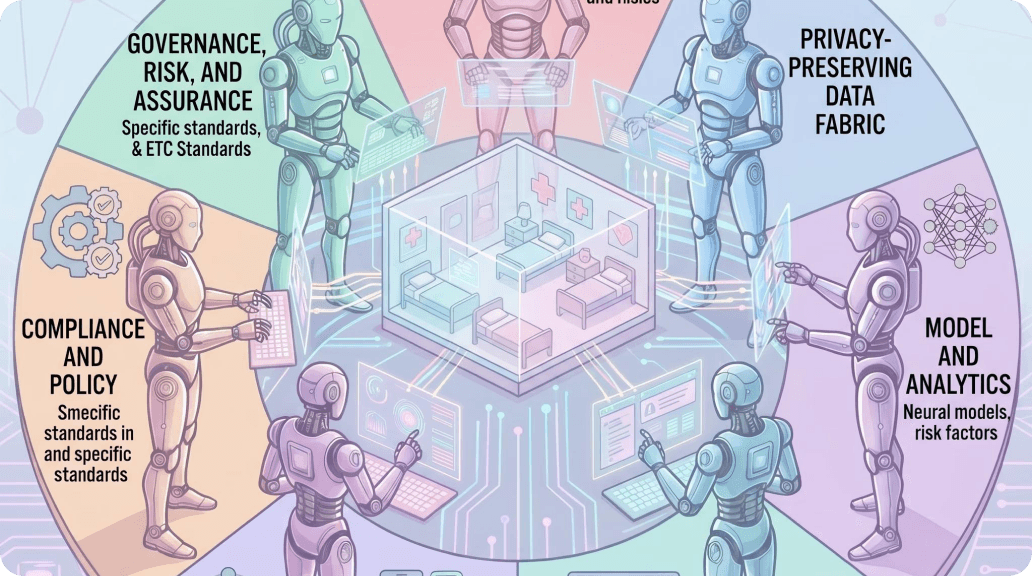
This research introduced an extended seven-layered architecture designed to move hospital AI from fragmented, single-LLM chatbots to a governed ecosystem of specialized agents (conversational, orchestration, reconciliation, auditing, and decision-support).
The study defined a comprehensive taxonomy of Agentic AI patterns specifically tailored for Hospital Information Management Systems (HIMS) workflows, such as ED triage management, bed assignment, discharge summaries, and claims reconciliation.
A key innovation of this research is the mapping of each Agentic pattern to operational risk tiers (low, medium, high, safety-critical). This ensured that high-risk clinical tasks mandate human-in-the-loop oversight and stricter policy checks, aligning with international regulations.
The framework presented in this research features a centralized control plane capable of registering, configuring, and monitoring multiple agents across major HIMS platforms (like Epic, Cerner, and MEDITECH). It dynamically evaluated risk tiers and applied policy-as-code to govern agent actions.
The architecture integrates governance directly into the runtime, ensuring that every agent invocation complies with regulations such as HIPAA, GDPR, the EU AI Act, and India's DPDP Act 2023 and India’s upcoming Digital Information Security in Healthcare Act (DISHA) Act. This creates a traceable and auditable system with global adaptability readiness.
The framework incorporates Virtual Large Language Models (vLLM) utilizing paged attention and efficient Key-Value cache sharing. This allows the system to support multiple concurrent clinical users with bounded, sub-second latency, crucial for time-sensitive hospital operations.
The design assumes no direct public internet access for critical components. Protected Health Information (PHI) is secured at-rest, in-transit, and in-use through confidential computing enclaves and Model Context Protocol (MCP) servers deployed within private subnets.
The architecture is designed to support diverse data-localization regimes, offering blueprints for MCP-based on-premise, hybrid, and full-cloud deployments while maintaining identical governance semantics.
Manideep Dhar
ResearchGateSharat Chandra Kumar Manikonda
ResearchGateRitwik Singh
Academia Research
Research · Jun 2026
PublicationReleasing soonPublication · Coming Soon